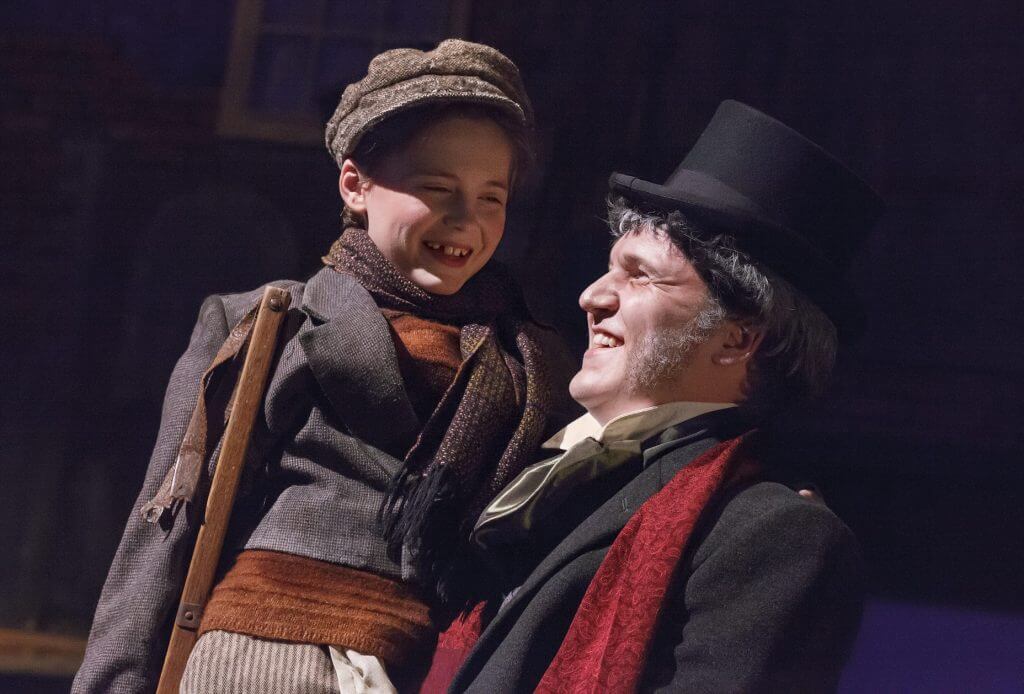
I don’t have to summarize the plot of Charles Dickens’s A Christmas Carol in Prose, Being a Ghost Story of Christmas, do I? Everyone knows the story of Ebenezer Scrooge and his life-changing encounter with three ghosts on Christmas Eve. Even if you’ve never read the book, you’ll have seen at least one version of it (my favorite is the 1992 version starring Michael Caine as Scrooge and Kermit the Frog as Cratchet, though I also highly recommend the 1938 adaptation with Reginald Owen and Gene Lockhart).
The story is so familiar that we often forget just what an original tale it is.
Coming from the master of the caricature himself, Charles Dickens, the story takes one of Dickens’s typical villains—a loveless, greedy old man—and casts him as the protagonist, while Dickens’s typical heroes—the honest, cheerful young gentleman and the hardworking family man—are relegated to supporting roles. The story then proceeds to invite the audience to sympathize with Scrooge; to ask what made him what he is now and what fate he has to look forward to.
What emerges from the ministrations of the three ghosts, especially the Ghost of Christmas Past, is that what Scrooge truly despises is less Christmas itself than love. Crushed in early life by the double blow of a sister who died young and a romance that failed through his own over-caution, Scrooge has become convinced that love is a lie: whatever people say, sooner or later they will all abandon you in the end. Hence his response to anyone wishing him a Merry Christmas: ‘humbug,’ meaning a trick or pose.
Scrooge sees love in general, and Christmas in particular, as a cheat: an attempt to bilk him by people who, whatever they profess, are really just as selfish as he is. When his nephew informs him that he got married because he fell in love, Scrooge considers that to be the only thing in the world more ridiculous than a Merry Christmas.
The story is of Scrooge coming to see that this is not so: that there is love and joy and charity to be had in the world, especially about Christmas time, if he will only take it.
As I say, we all know the story. So what’s my point in repeating it?
It is this. Many of us, I think, have had similar experiences to Scrooge in the past.
Many of us have been hurt or disappointed or rejected in love. Many of us are afraid to expose our hearts to that kind of pain again. And, unfortunately, it is even easier to retreat into isolation now than it was in Mr. Dickens’s time. Scrooge at least had to walk down crowded streets and speak to his clients face-to-face. We can wrap ourselves in a technological bubble practically wherever we go, shielding ourselves from any contact with the uncongenial world around us.
It is understandable that we who have been hurt would wish to avoid the possibility of experiencing that kind of pain again. Understandable, but misguided. As the ghost of Marley said, it is required of all of us that we should walk abroad among our fellow men, and to do so is to find happiness. Scrooge allowed his own bitterness and grief to rob him of many years of this happiness. Every one of us risks doing the same if we try to guard our hearts too zealously.
Though the risk of pain must always be there, the potential for joy is far greater.
Moreover, it oughtn’t be about us.
We ought not to go out wondering what others can or should or will do for our sake, but what we may do for theirs. Scrooge’s nephew Fred understood this. Year after year, he endured a tongue-lashing from his uncle on the off chance that the old man would finally accept a little Christmas cheer. His unrelenting desire to do his uncle good makes him proof against all of Scrooge’s insults and harsh words.
By focusing on what he could do for his uncle’s sake, young Fred effectively shielded himself against being injured in return. A will do to others good is a strong defense against the pain of rejection.
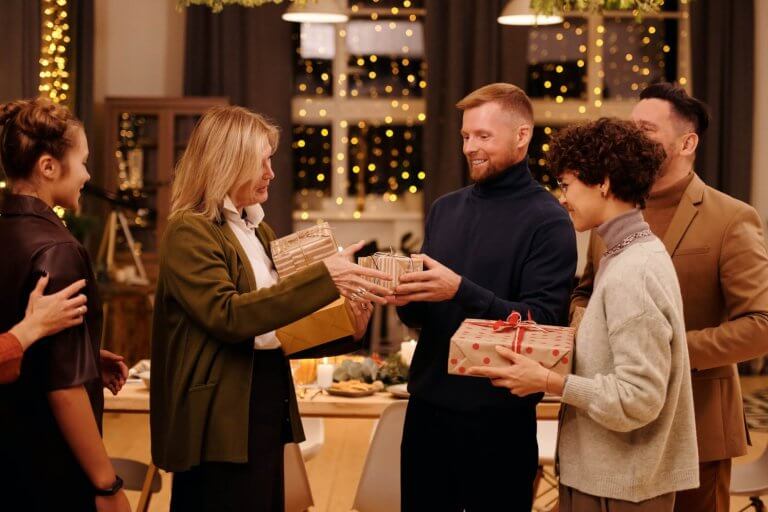
There is a wonderful scene at the end of the Michael Caine adaptation, in which the changed Scrooge offers a very large donation for the poor to a pair of charitable gentlemen. In response, he’s surprised when one of the gentlemen shows his gratitude by offering Scrooge his first Christmas gift in who knows how many years. Having set about to give freely, Scrooge finds, to his great joy, that he is able to receive freely in return. In offering love and kindness, he invites love and kindness, and all it brings.
This Christmas, don’t just read the story of Scrooge: live it.
Take the season as an opportunity to open your heart to others by offering them love and kindness. Give it freely, for their sake, without seeking to receive it. Think first of how you can help or affirm the people you meet and don’t think of how they might reciprocate.
This is hard, especially if you are lonely and have been hurt in the past, but it’s only by so doing that we can begin to heal. As you go about, whether to work or to family gatherings, or just out and about in the world, strive to offer love to all those you meet. You are liable to find yourself receiving as much back in return.